
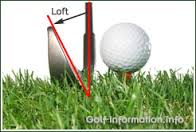
Effect of Loft on Carry Distance

loft picture

The Effect of Loft

The loft of an iron has a much greater effect on the distance your ball will carry than does the length of the club (swing speed).  Many in the golf industry estimate that with irons, the ratio is  as high 20:80,  meaning that loft has 4 times the effect on distance as compared to swing speed.  At a swing speed around 78 miles per hour and a club length of 37 inches every degree in change of loft will result in a much greater difference in distance than a 1 mph change in club head speed.

The long and the short of it is that when you reduce the length of your irons to a 7 iron length (in the case of the irons longer than a 7 iron), and lengthen the shafts on the 8 iron to the wedges to the 7 iron length you will affect swing speed generated by those clubs.

How to compensate 

With single length irons the change in loft is the primary factor in terms of compensating for the loss in distance with the 3-6 irons, and the gain in distance for the iron through wedges.  The lofts on the longer irons are strengthened while on the shorter irons they are decreased.

There is another factor that plays into this as well, that being club head weight. Physics tell us that when a moving object (the club head) strikes a stationary object (the ball) the amount of force applied to the ball is dependent on two factors, the speed of the moving object, and its weight.  It is akin to a 20 ton truck travelling at 60 kph and striking a light standard knocking it over, and a Smart-car traveling at the same speed striking the same  light standard and scuffing the paint on the pole.

Because the heads on single length clubs are all the same weight (around 272 grams) the head on the 4 iron is 20-25 grams  heavier than a traditional 4 iron and will exert more force causing a slight increase in distance.  The head on the pitching wedge which is approximately 20 grams lighter than the traditional weight  will exert less force and cause a slight decrease in distance.

Conclusion

By varying the loft of the irons, other than the 7 iron which is the standard, it is theoretically possible to build a set of clubs that are all the same length and still hit the ball distances very similar to traditional clubs while at the same time  ensuring the wedge to 8 iron don’t go to far and the 3 to 6 iron go far enough to maintain a workable ‘gap’ in terms of the different distances each club will hit the ball.

In my mind the disadvantages addressed in an earlier post can be compensated for, leaving only the advantages, which I would argue are so beneficial that a strong argument can be made at least putting the concept to the test as opposed to dismissing it out of hand.

As indicated in an earlier post I am in the process of assembling a set of single length irons.  I have experimented with lengths ranging from 35 to 37.5 inches and different combinations of lie angles.  I am getting close to arriving at what will be my ‘final’ specifications and when I do I will be writing a post about the finished product.

Do you play in windy conditions?  Try the Windcard.
Introducing the “Windcard”

Advantages and disadvantages of single length irons

When you think about the concept of a set of irons that are all the same length both advantages and disadvantages become apparent.

Advantages

  1.  Because each iron is the same length (roughly equivalent to a 7 iron)  your set up position will be the same with each club in the set.  You will be standing the same distance from the ball with each club.  The ball position (forward or back in relation to your feet) will be the same for each club.
  2. Because all clubs in the set are the same length and have the same lie angle your swing plane will be identical for each club.  With conventional clubs the swing plane with the short irons is more upright (than a 7 iron) and more flat with the longer irons. Theoretically it is easier to master one swing plane than multiple swing planes.
  3. As the shafts are all the same length and the heads all weigh the same each club will have an identical shaft flex and  swing weight.
  4. MOI (moment of inertia) will be identical for each club.
  5. The bounce angle and offset for each club is identical (with the exception of the sand wedge).

Disadvantages

  1. Because each club is the same length and the heads are all the same weight your swing with the 8 iron through lob wedge (which are longer than a conventional set) will be faster and the ball will go further.
  2. With the 3-6 irons (which are shorter than a conventional set) your swing speed will be slower and the ball will not go as far.
  3. It may be difficult to achieve the traditional 10 yard ‘gap’ between clubs.

In a subsequent post I will examine the impact of club length on swing speed (and distance), as well as the effect of club loft on distance with a view to eliminating the two ‘disadvantages’ to single length irons.


Single Length Golf Clubs

What are single length clubs?

As the name implies, single length clubs are a set of golf clubs where all the irons (but not the hybrids and woods) are the same length.

I first started dabbling with the notion of a set of irons that were all the same length long before the Internet was prominent.  Back then (late 70’s early 80’s) there were very few, if any, good sources of information on the topic so basically I reverted to the tried and true method called experimentation.

What caused me to start down that road was a realization that I think all golfers come to at some point in time, that being: there are one or two irons in the set that you hit much better than the other irons in the set.

For most golfers, that one favorite club that feels better and results in better shots is the 7 or 8 iron and in some cases the 6 iron.  I’ve heard many golfers say, “if I could just hit the rest of my clubs like I hit my  seven iron, I’d be a pretty good player”.

Back then I did not understand much about swing planes, and had only a rudimentary understanding of the prevailing principles of golf club construction.

To address this issue I decided I needed to get some instructional material about how major manufacturers assembled golf clubs and the principles they employed so I purchased some books on golf club assembly.  Before I knew it, I was  assembling golf clubs at first for my own use and soon thereafter for friends and fellow golfers.

Traditional golf club length and head weight

Traditional golf club assembly principles dictate that clubs are progressively longer through the set.  Wedges start around 35 to 35.5 inches in length and then each club is built 1/2 inch longer so by the time you get to a 3 iron it is around  39 inches long.

To accommodate these changes in club length the lie angles change starting around 64 degrees for wedges and progressing to  59 degrees for a 3 iron.  The head weights also change starting around 300 grams for a sand wedge and arriving by increments at 230 grams for a 3 iron.  In theory the difference in head weight and shaft length from a wedge to a 3 iron should result in a set of clubs that all ‘feel’ the same.  The shafts are ‘tipped’, which means shaft material is removed from the lower end of the shaft to make them progressively stiffer as the heads get heavier.

Mass Produced Single Length Clubs

In 1986 the Tommy Armour Golf Company produced a set of clubs called EQL (equal length).  These clubs featured a head very similar to the Armour 845’s which were popular at the time.  The difference was all the heads weighed around 260 grams and all the irons were the  length of a 6 iron.  Because the idea of single length irons was considered too radical a departure from the norm, Armour was not able to get any prominent professionals to play or endorse the clubs.  As a result the idea was scrapped and production was halted.

The EQL irons were inspired in large part by Moe Norman’s swing.  Norman, who used a single plane swing, choked down on most of his irons to the point where he was in reality hitting what amounted to single length irons.

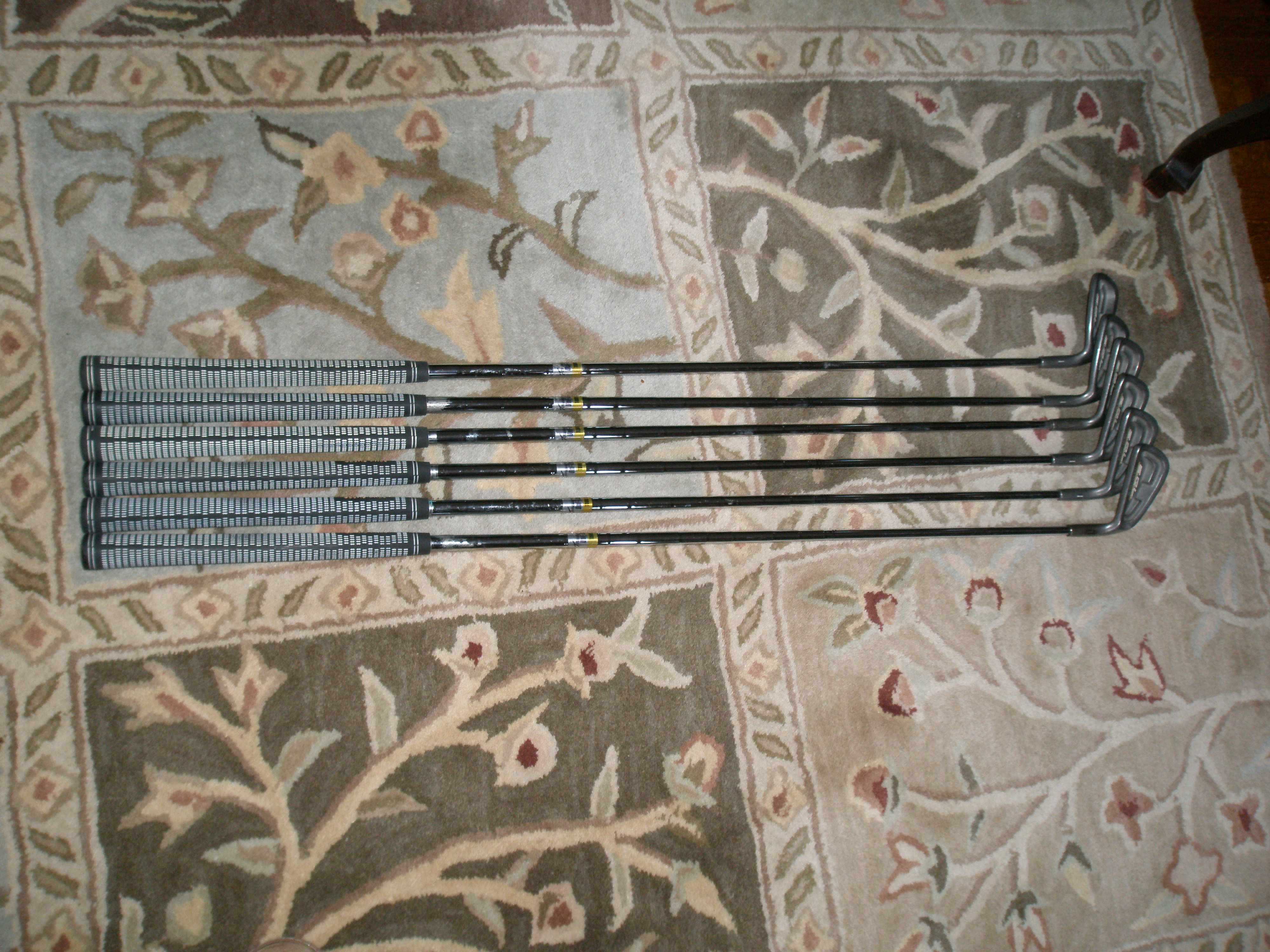
I have a set of EQL’s and they are pictured below.


OLYMPUS DIGITAL CAMERA


EQL2Although I have played these clubs with some success I was never a fan of the  offset Armour 845 heads.

My Winter Project

Being a fan of Bryson DeChambeau who uses not only single length clubs, custom-made for him by Edel Golf but also a single plane swing, I have decided I need to build myself a set of new single length irons.  Although you can now purchase custom-made single length irons the cost is substantial.

I have settled on Pinhawk heads.  They are available from flop wedge through 4 iron (with an optional 4 hybrid) with a lie angle of 62.5 degrees and a head wight of 272 grams throughout the set.  The head I have selected is pictured below.

pinhawk-sl-single-length-irons (1)

I will keep you posted.