Single Length Golf Clubs

What are single length clubs?

As the name implies, single length clubs are a set of golf clubs where all the irons (but not the hybrids and woods) are the same length.

I first started dabbling with the notion of a set of irons that were all the same length long before the Internet was prominent.  Back then (late 70’s early 80’s) there were very few, if any, good sources of information on the topic so basically I reverted to the tried and true method called experimentation.

What caused me to start down that road was a realization that I think all golfers come to at some point in time, that being: there are one or two irons in the set that you hit much better than the other irons in the set.

For most golfers, that one favorite club that feels better and results in better shots is the 7 or 8 iron and in some cases the 6 iron.  I’ve heard many golfers say, “if I could just hit the rest of my clubs like I hit my  seven iron, I’d be a pretty good player”.

Back then I did not understand much about swing planes, and had only a rudimentary understanding of the prevailing principles of golf club construction.

To address this issue I decided I needed to get some instructional material about how major manufacturers assembled golf clubs and the principles they employed so I purchased some books on golf club assembly.  Before I knew it, I was  assembling golf clubs at first for my own use and soon thereafter for friends and fellow golfers.

Traditional golf club length and head weight

Traditional golf club assembly principles dictate that clubs are progressively longer through the set.  Wedges start around 35 to 35.5 inches in length and then each club is built 1/2 inch longer so by the time you get to a 3 iron it is around  39 inches long.

To accommodate these changes in club length the lie angles change starting around 64 degrees for wedges and progressing to  59 degrees for a 3 iron.  The head weights also change starting around 300 grams for a sand wedge and arriving by increments at 230 grams for a 3 iron.  In theory the difference in head weight and shaft length from a wedge to a 3 iron should result in a set of clubs that all ‘feel’ the same.  The shafts are ‘tipped’, which means shaft material is removed from the lower end of the shaft to make them progressively stiffer as the heads get heavier.

Mass Produced Single Length Clubs

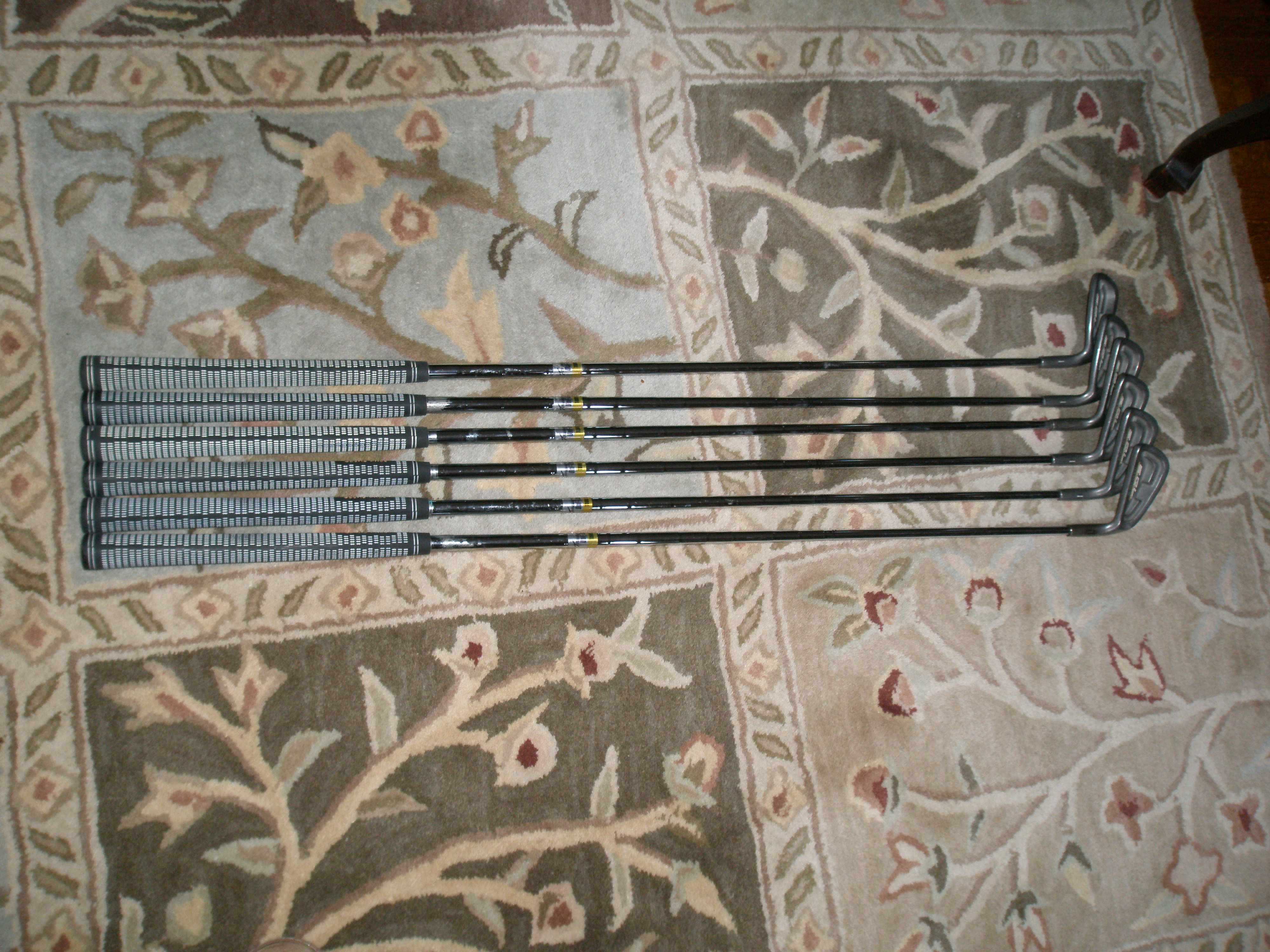
In 1986 the Tommy Armour Golf Company produced a set of clubs called EQL (equal length).  These clubs featured a head very similar to the Armour 845’s which were popular at the time.  The difference was all the heads weighed around 260 grams and all the irons were the  length of a 6 iron.  Because the idea of single length irons was considered too radical a departure from the norm, Armour was not able to get any prominent professionals to play or endorse the clubs.  As a result the idea was scrapped and production was halted.

The EQL irons were inspired in large part by Moe Norman’s swing.  Norman, who used a single plane swing, choked down on most of his irons to the point where he was in reality hitting what amounted to single length irons.

I have a set of EQL’s and they are pictured below.
 

OLYMPUS DIGITAL CAMERA


EQL2Although I have played these clubs with some success I was never a fan of the  offset Armour 845 heads.

My Winter Project

Being a fan of Bryson DeChambeau who uses not only single length clubs, custom-made for him by Edel Golf but also a single plane swing, I have decided I need to build myself a set of new single length irons.  Although you can now purchase custom-made single length irons the cost is substantial.

I have settled on Pinhawk heads.  They are available from flop wedge through 4 iron (with an optional 4 hybrid) with a lie angle of 62.5 degrees and a head wight of 272 grams throughout the set.  The head I have selected is pictured below.

pinhawk-sl-single-length-irons (1)

I will keep you posted.

Standard Length and Loft For Irons

00024201

Is there such a thing as a ‘standard’ set of golf clubs in terms of length and loft?

The answer is yes and no.

In the days of drivers with steel shafts and persimmon heads, the standard length for a driver was 43 inches.  With the introduction of graphite shafts and titanium heads the new standard for drivers is 45+ inches.

In terms of irons, in the 1970’s most golf manufacturers adhered to what was known at the 24/38 rule when it came to iron loft and length.  That rule says that the average male golfer could be expected to hit a golf club with 24 degrees of loft and an overall length of 38 inches approximately 170 yards.  Irons with a lower loft or a longer shaft was reserved for the very accomplished or elite players.  In the 1970’s on average a 3 iron had 24 degrees of loft and was 38 inches long.

Fast forward to today and despite the improvements in club heads, shafts and grips the 24/38 rule still applies.  The average male golfer still hits a club with 24 degrees of loft and an overall length of 38 inches, 170 yards.  What has changed is that the number assigned to the club has changed from a ‘3’ to a ‘5’.  In terms of specifications, today it’s the 5 iron and not the 3 iron that has around 24 degrees of loft and an overall length of 38 inches.

What caused this loft and length creep?  In a word, marketing.  The large golf club manufacturers found themselves in a very competitive situation and in an attempt to set themselves apart, manufacturers would produce clubs with claims of greater distance. Remember those ads that claim ‘our clubs are one club longer”, or “two clubs longer” than the competition? Well, they were not really one club longer.  When you take a 7 iron and substantially decrease the loft and extend the shaft by up to an inch  you have effectively turned it into a 6 iron and yes, 6 irons  will go further than 7 irons. Between 1970 and the present most if not all club manufactures have strengthen the lofts, and extended the shafts on off the counter iron sets, effectively creating a new ‘standard’ in terms of iron loft and length.

The table  below shows how the loft and length of clubs has changed from 1970 to the present.  The data in this table represents industry averages.  There are some variations that fall outside the averages;  for example the new Titleist AP1 irons start with a 19 degree 3 iron, as do the new Taylormade  PSi irons, with more aggressive lofts throughout the set.    

Loft Length
Iron 1970 Current 1970 Current
3 24 20 38 39
4 28 23 37.5 38.5
5 32 26 37 38
6 36 32 36.5 37.5
7 40 34 36 37
8 44 38 35.5 36.5
9 48 42 35 36
PW 52 46 35 35.5

The next time you hear a commercial about irons that go further, check the lofts and lengths before you buy them.  It might be much more economical to simply take a sharpie and write a different number on the bottom of your iron and perhaps lengthen the shaft by a half an inch, than buying into the hype and spending money on a new set.

Do you play golf in windy conditions?   Try the Windcard.

Introducing the “Windcard”

Longer, Straighter, Higher, Faster

The average handicap for players in United States has remained largely unchanged for the last 40 years

As a golf nut, I watch, read and listen to most everything that has to do with golf. That means I watch infomercials, read new product reviews, listen to golfers who have just purchased new equipment, and try out new equipment when the opportunity arises (which it seems to quite frequently).

I have yet to come across a golfer who says, “I just got this new driver because my old one just went too far”.  I hear a lot more of, “this new driver goes 20-30 yards further than my old one”.  Commercials and infomercials convey the same message. They will usually tell you something (sometimes a lot) about a new product and conclude with a testimonial or two about how, “I’ve never hit a club that went, this far”, or for that matter “this straight” or “this high” or “this low” depending on the product being sold.  This scenario applies to drivers, fairway woods, hybrids and irons.

And it goes beyond clubs.  Ball manufacturers are in on the act as well.  Despite the fact that the USGA has restrictions on how far balls can  go, companies persist in telling us that their ball, although USGA approved, goes further than the competition.

Golf tee manufacturers are in on the act as well claiming that their tees will help you drive the ball an extra 2 to 3 yards off the tee.

As indicated in an earlier article, in golf there is no substitute for distance, so if a manufacturer can prove, or at least claim with a straight face, that their  clubs will make the ball go further, or that their ball goes further than other balls, golfers tend to buy it.

In my mind there have been but a few eureka moments in golf in the last 30-40 years where manufacturers changed the game and the way the average golfer plays it in a dramatic way.

1   cast perimeter weighted irons (the Ping revolution);

2  the move from wooden woods to metal woods;

3  the move from the smaller steel heads to the 460 cc titanium heads with thin faces that tend to sling-shot the ball when hit off the center of the face (the trampoline effect);

4  the introduction of hybrids.

As well, let’s not forget shaft material.  Although the big leap occurred before my time, going from hickory to steel was the big jump but even after the introduction of steel shafts manufactures have dabbled in aluminum, titanium and other metals.  The standard nowadays, especially for long clubs, is graphite. With its lower overall wight and precision engineered kick points, graphite has proved to be a consistent performer  when it comes to distance and determining ball flight.

Lastly, the ball.  Where would we be without solid core, multi-layered, soft covered balls  like the ProV1 and its many competitors.

Be careful that you don’t buy new equipment that will make the ball go so far that it makes the current course you play obsolete (he said tongue firmly panted in cheek).

How has this affected the average golfer?  Lets say for the sake of argument you hit the ball 240 yards off the tee and you hit your 7 iron around 150 yards.  That means you should be very comfortable playing par 4’s  up to 390 yards in length, (a 240 yard drive and a 150 yard approach shot).  Lets add-on some of the main  game improvement claims:

Driver         20 -30 yards

Irons           10-15 yards

Ball              10-15 yards

Tees             3-4 yards

Now you play that same 390 yard par 4.  You are hitting your driver from 270 to 285 yards off the tee leaving you an approach shot between 105-120 yards.  And because of the improvements in irons and balls,  an approach  shot that previously would have required anywhere from a gap wedge to a 9 iron now requires only a flop wedge or a sand wedge.

Here is the punch line:  With all your game improvement investments on full display  you hit your flop wedge onto the green and 3 putt for a bogie.  Everything has changed yet nothing has changed.

Despite all the game improvement equipment  that has been introduced you still cannot buy a game.  According to the USGA the handicaps for American golfers have been static for the last 40 years despite all the equipment improvements.