
Who are Homer Kelley and Bryson Dechambeau

When it comes of finances and politics I am conservative by nature, however when it comes to golf I’m willing to try almost anything.

Some years ago I picked up a copy of Homer Kelley’s book The Golfing Machine.
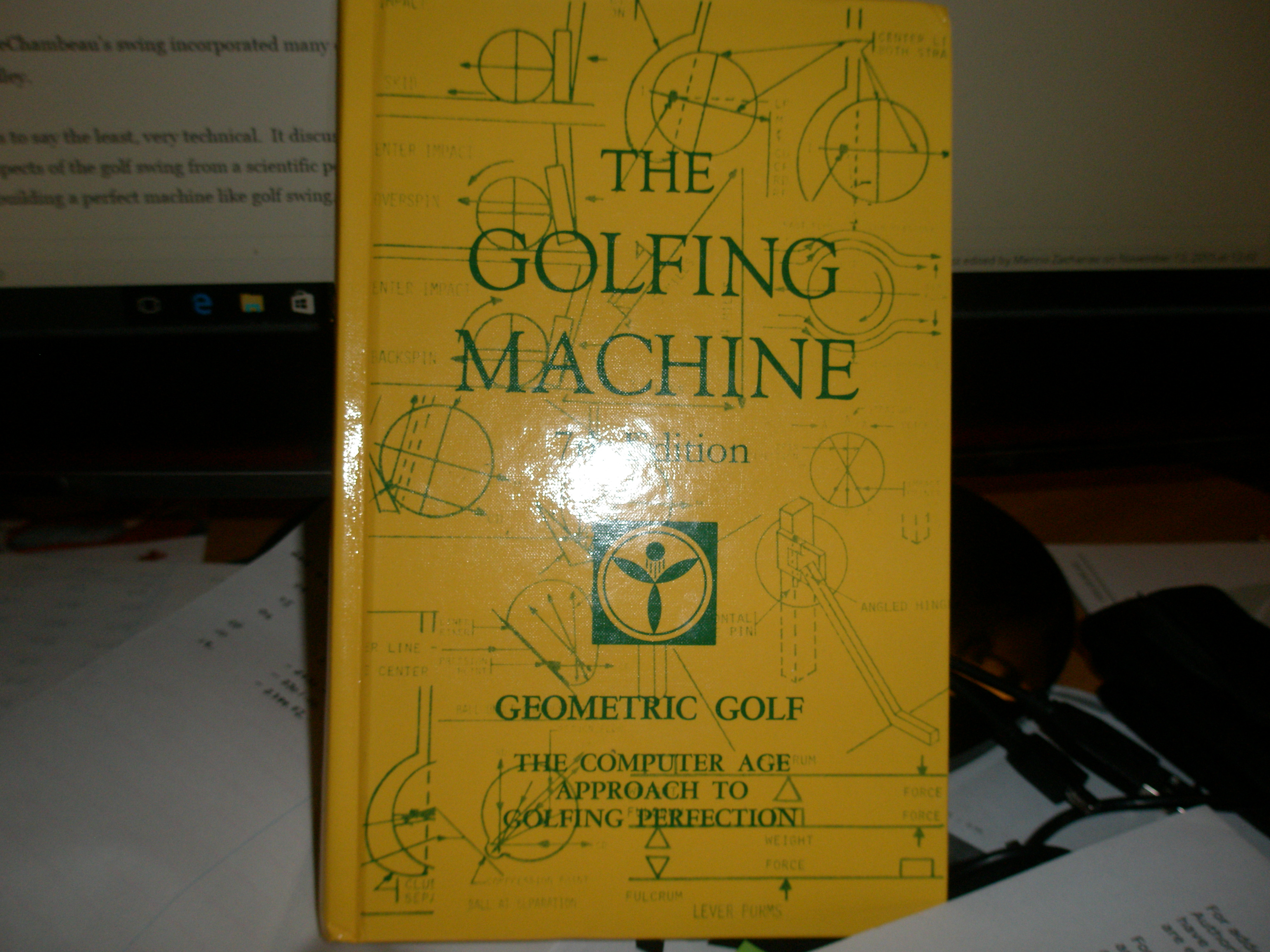
OLYMPUS DIGITAL CAMERA

When I read it for the first time I realized it would have been helpful if I had a PhD in physics.  I had a difficult time grasping some of the material in the book so I put it one the shelf for a while.

Last spring my interest in the book was renewed.  I watched Bryson DeChambeau win the NCAA Individual  Championship, and then follow it up with a win at the US Amateur, a feat accomplished only by Jack Nicklaus, Phil Mickelson, Tiger Woods and Ryan Moore.  I realized I needed to consult Homer Kelley’s book again.

I realized that DeChambeau’s swing incorporated many of the key principles espoused by Kelley.

Kelley’s book is to say the least, very technical.  It discusses in great detail the mechanical aspects of the golf swing from a scientific perspective, using physics and geometry as the basis for building a perfect machine like golf swing.

When I watch DeChambeau swing a golf club I see aspects of Homer Kelley’s theories  as well as  some of the principles of  Natural Golf as practiced by Moe Norman come together in perfect unity.

Click here for a short video of DeChambeau’s swing.  There is also a  video where DeChambeau talks about his clubs and demonstrates his swing and a swing training device he uses.

His clubs look like this

Bryson-Single-Length-Irons

Like Moe, DeChambeau uses a single plane swing.  However, he has taken it several steps further than Moe did by executing that swing using a set to specially designed irons that are all the same length.

To say that I am looking forward to see DeChambeau play professional golf is an understatement.

He may well be poised to take ball striking to a whole new level.

Update January 15, 2016    Dechambeau hires an agent and is looking at equipment sponsors


How Many Sets of Golf Clubs Do You Have

OLYMPUS DIGITAL CAMERA
A few of my ‘extra’ clubs


For those who have golfed with me over the years this will come as no surprise. One of the things I really enjoy is either changing out my entire set of clubs, or at least of few of the clubs in my set with great frequency.

Why you may ask?  When you play as much golf as I do you need to do things that stimulate continued interest and concentration and changing clubs does that for me.

As well, there are times when I configure my set in keeping with the course that I will be playing.  For example, if I’m playing at Wildewood, which is a relatively short (6048 yards) course that has a lot of trees and ball positioning off the tee is of prime importance, I might opt for a low lofted (13 degree) 3 wood to use for tee shots on some of the shorter and narrow par 4’s.  I might also remove one of the longer hybrids and substitute an additional wedge.  At times I will even remove my regular driver from the bag and use a 12 degree ‘mini driver’ for accuracy purposes.

When playing a longer course such as Bridges where distance is more important and lack of accuracy is not as severely punished I might again remove my regular driver and replace it with a longer driver with an overall length of 47 and 7/8 inches to add distance off the tee.   I might also pull out one of the wedges and add a low lofted (17 degree) hybrid.

Other times I might simply swap out my entire set of irons either just for a change or to compensate for some temporary anomaly in my swing.  If for example I go through a phase where I’m drawing my irons I may use a set of forward progressed irons that tend to promote a slight fade, or conversely if I’m fading the ball I made used a set of irons with a slight offset to promote a straighter ball flight.

At times my swing may get out of whack and if I find I’m hitting a lot of fat (club makes contact with the ground behind the ball) shots or when the course conditions are wet and sloppy I’ll revert back to a set of irons that consist entirely of hybrids.

On other days when I’m just feeling adventurous I may bring out a set of irons that are all the same length, with heads that all have the same weight.  This type of club allows you to position the ball identically for each club as the only thing that changes from club to club is the loft angle.  This means you are able to use exactly the same swing with each club.

So how many sets of clubs to I have, well right now I have 5 sets of irons and an assortment of drivers an fairway wood in different combinations of loft and shaft length, a descent collection of hybrids in different lofts, an assortment of wedges and a few putters.

This array of clubs allows me to configure different set of clubs to suit my game, the course I’m playing or just the mood I happen to be in.

Does anyone else do this?

Which Are the Hardest Scoring Holes

Par 3’s, Par 4’s or Par 5’s

Most mid to high handicap golfers will tell you that the holes they score best on are the par 3’s while they have the most difficulty on the par 4’s and par 5 respectively.

I recently looked at my 2015 scoring stats using the game tracker feature on the Golf Canada handicap score entry site.  The following are my scoring averages for the year:

Par 3’s          3.3     (+.3)

Par 4’s          4.2     (+.2)

Par 5’s          5.0     (even)

These numbers would seem to fly in the face of the conventional wisdom that par 3’s are the easiest scoring holes.

So I decided to delve a little deeper into this issue.  I looked at the scoring statistics for the 2015 Manitoba Amateur Golf Championship,    which was conducted at Bridges Golf Course and featured many of the premier golfers in Manitoba.  First I looked at the scoring average for the players who finished in the top ten for the Championship.  Their scoring results were as follows:

Par 3’s          3.12     (+.12)

Par 4’s          4.07     (+.07)

Par 5’s          4.81     (-.19)

These result tended to mirror my experience in that the lowest scores relative to par were on par 5 holes and the highest on par 3 holes.

Next I looked at the scores for the 10 players who finished last in the Championship and failed to make the cut.  Their scoring averages reflected a different pattern:

Par 3’s          3.86     (+.86)

Par 4’s          5.2       (+1.2)

Par 5’s          6.37     (+1.37)

This group indeed scored best on the par 3’s and had their highest scores (relative to par) on the par 5’s.

In a subsequent post I will examine why this variation in scoring averages on holes with different pars exists between players of  different levels of golfing proficiency.

Any thoughts?